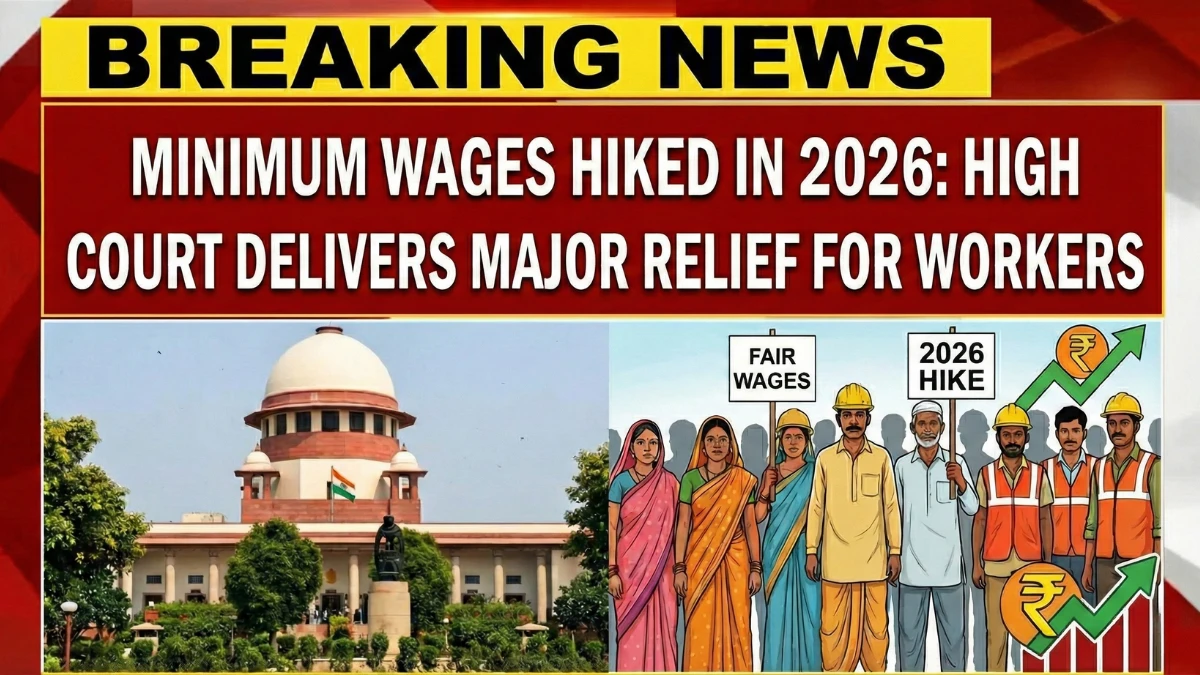
The Minimum Wages Hike in 2026 marks a significant victory for workers after a High Court ruling directed authorities to revise wage rates, ensuring fair pay in line with rising inflation, living costs, and basic dignity of labour, offering immediate financial relief to millions of workers across multiple sectors.
Why the High Court Ordered a Minimum Wage Hike
The court observed that existing wage rates had become outdated and insufficient due to sharp increases in food prices, housing costs, healthcare expenses, and inflation, stressing that minimum wages must guarantee a basic standard of living, not just survival.
Minimum Wages 2026: What Has Changed
| Category | Earlier Situation | New Update (2026) |
|---|---|---|
| Wage Revision | Delayed or stagnant | Mandatory hike ordered |
| Inflation Adjustment | Inadequate | Cost-of-living linked |
| Worker Coverage | Limited sectors | Wider applicability |
| Legal Backing | Weak enforcement | Strong court directive |
| Effective Period | Old rates | From 2026 onward |
Who Will Benefit from the Wage Hike
The decision benefits daily wage workers, contract labourers, industrial workers, construction workers, factory staff, and unorganised sector employees, especially those earning close to statutory minimum wage levels.
Impact on Workers’ Income and Living Standards
With higher minimum wages, workers can expect better monthly income, improved purchasing power, reduced debt dependency, and stronger financial stability, particularly for families dependent on a single earning member.
Employer Responsibilities After the Court Order
Employers are legally required to implement revised wage rates, maintain proper wage records, and ensure timely payments, failing which penalties and legal action may follow under labour laws.
State Governments’ Role in Implementation
While the High Court ruling sets the framework, state governments must notify revised wage rates, sector-wise classifications, and enforcement mechanisms to ensure uniform implementation at ground level.
Key Points Workers Should Know
- Minimum wages revised under court direction
- Higher pay effective from 2026
- Applies to organised and unorganised sectors
- Employers legally bound to comply
- Non-payment can be legally challenged
What Workers Should Do Now
Workers should check updated wage notifications, keep salary slips or payment proof, report violations to labour departments, and avoid accepting payments below revised minimum rates.
Conclusion
The Minimum Wages Hike in 2026 following the High Court verdict is a landmark step toward wage justice, reinforcing the principle that fair pay is a legal right, not a privilege, and strengthening protections for India’s working population.
Disclaimer
This article is based on court rulings and labour policy updates. Actual wage amounts, categories, and implementation dates may vary by state and sector as per official government notifications.