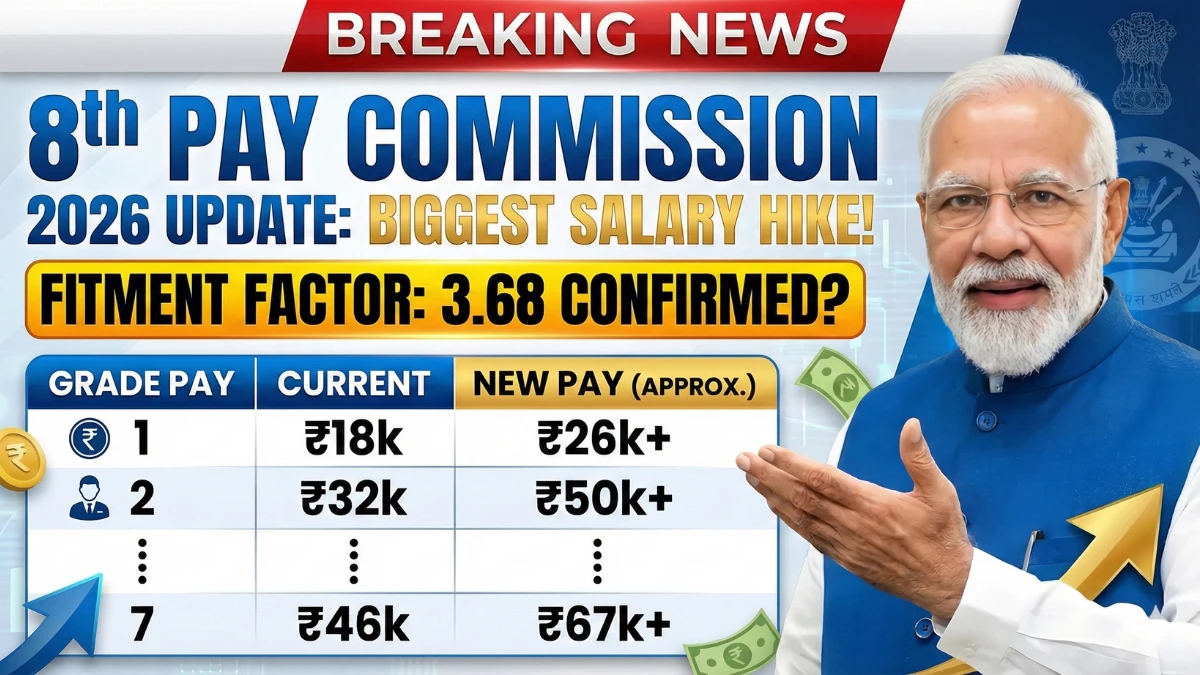
The Pay Levels 1–18 salary hike in 2026 has become a major talking point as discussions point to a fitment factor of 2.06 for central government employees. If implemented, this revision would impact over 1 crore employees and pensioners, reshaping basic pay, allowances, and pensions across all pay levels. While final approval is awaited, understanding how the 2.06 fitment factor works is crucial to estimating the real impact on take-home pay.
Why the Fitment Factor 2.06 Is Being Considered
The fitment factor is used to revise basic pay under a new pay framework by multiplying the existing basic salary. Policy-level deliberations under the Government of India suggest that a moderate fitment factor like 2.06 helps balance employee expectations with fiscal sustainability, especially given inflation control measures and long-term salary commitments.
Pay Levels 1–18 Salary Revision 2026 – Snapshot
| Item | Details |
|---|---|
| Pay Levels Covered | Levels 1 to 18 |
| Proposed Fitment Factor | 2.06 |
| Beneficiaries | Central govt employees & pensioners |
| Impact Areas | Basic pay, DA, HRA, pension |
| Status | Under discussion |
How the 2.06 Fitment Factor Impacts Salaries
Under a 2.06 fitment factor, the existing basic pay is multiplied to arrive at the revised basic. This directly increases Dearness Allowance (DA), House Rent Allowance (HRA), Transport Allowance (TA), and other benefits linked to basic pay. Although the increase may be lower than higher expectations, it still represents a meaningful revision across all pay levels.
What Pay Levels 1–18 Can Expect
Lower pay levels benefit from a uniform uplift that raises minimum pay, while higher levels see proportional increases that also affect retirement benefits. Pensioners benefit through revised basic pension calculations, as pensions are linked to the updated pay matrix.
Impact on Pensioners and Arrears
Pensioners stand to gain from revised pensions based on the new fitment factor. If implementation is delayed after approval, arrears may be payable from the effective date, subject to official notification.
Employee Unions’ View
Employee unions have sought a higher fitment factor, arguing that living costs and inflation justify a stronger revision. However, the 2.06 factor is being viewed as a compromise approach pending final decisions.
Key Highlights of Pay Levels 1–18 Salary Hike 2026
- Fitment factor of 2.06 under consideration
- Covers all pay levels from 1 to 18
- Direct impact on allowances and pensions
- Final approval and timeline awaited
Conclusion
The Pay Levels 1–18 salary hike in 2026, based on a 2.06 fitment factor, could bring a broad-based increase for over 1 crore central employees and pensioners. While not the highest expected revision, it would still improve basic pay and long-term retirement benefits. Employees should watch for official announcements to confirm figures, timelines, and arrears eligibility.
Disclaimer
This article is for informational purposes only and is based on discussions, reports, and early policy signals available at the time of writing. The final fitment factor, pay matrix, and implementation date will be confirmed only through official notifications issued by the Government of India. Readers should rely on authenticated government releases for final and binding information.